What Is Local SEO and Why Does It Matter for Your Business?
Most businesses are invisible online to the customers closest to them. Local SEO fixes that. If you run a business that serves a specific city, suburb, or region, local SEO is the single most cost-effective way to get found by buyers who are ready to act.
Table of Contents
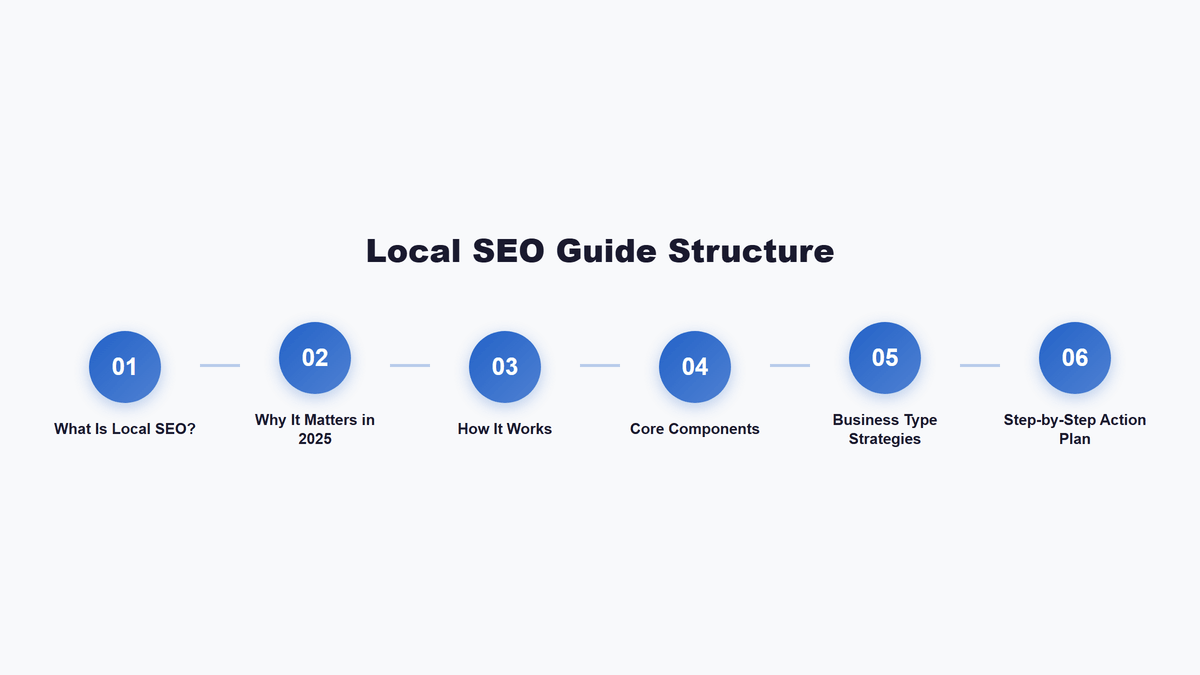
- What Is Local SEO?
- Why Local SEO Matters in 2025
- How Local SEO Works
- The Core Components of a Local SEO Strategy
- Local SEO for Different Business Types
- How to Get Started: A Step-by-Step Action Plan
- How Long Does Local SEO Take to Show Results?
- How to Track and Measure Local SEO Performance
- Is Local SEO Worth It for Your Business?
What Is Local SEO?
Local SEO (local search engine optimisation) is the process of improving your online visibility so your business appears in location-based search results. When someone searches “plumber near me” or “best cafe in Fremantle,” Google serves localised results tailored to that user’s location. Local SEO is how you show up in those results.
It is distinct from national or traditional SEO. Traditional SEO targets broad, high-volume keywords without geographic intent. Local SEO targets searches tied to a specific place, a suburb, a city, or a region, and uses a different set of ranking signals to determine what Google shows. If you are also running paid campaigns alongside your organic strategy, Google Ads management can complement local SEO by capturing immediate demand while your organic rankings build.
Local SEO vs. Traditional SEO vs. Paid Local Ads
| Feature | Local SEO | Traditional SEO | Paid Local Ads |
|---|---|---|---|
| Cost | Earned (time investment) | Earned (time investment) | Pay per click |
| Speed to results | 3 to 6 months | 6 to 12+ months | Immediate |
| Targeting | Location-based | Topic/keyword-based | Location + keyword |
| Placement | Map Pack + organic | Organic results | Above all results |
| Longevity | Compounds over time | Compounds over time | Stops when budget stops |
| Best for | Local service businesses | Broad audience reach | Fast lead generation |
What Types of Businesses Benefit Most from Local SEO?
Any business that relies on local customers benefits. This includes:
- Tradies and service businesses: Electricians, plumbers, cleaners, landscapers
- Health and medical practices: Dentists, physios, GPs, optometrists
- Retail and hospitality: Cafes, restaurants, gyms, retail stores
- Professional services: Accountants, lawyers, real estate agents
- Service-area businesses (SABs): Businesses that travel to clients, like pest control or mobile mechanics
Why Local SEO Matters in 2025
The numbers make the case clearly.
According to HubSpot, 46% of all Google searches have local intent. That is nearly half of all search activity globally pointing toward local businesses. The same research shows that 76% of people who search for something nearby visit a related business within 24 hours, and 28% of those searches result in a purchase.
BrightLocal reports that 97% of people learn more about a local company online than anywhere else, and 88% of consumers who do a local search on their smartphone visit or call a store within a day.
Nearly 9 in 10 local mobile searchers take a real-world action within 24 hours. Local SEO connects your online presence directly to foot traffic, calls, and revenue.
How Local SEO Levels the Playing Field
Large national brands have bigger budgets for traditional advertising. But local search results are determined by proximity, relevance, and prominence, not budget. A well-optimised local business can outrank a national chain for searches in its own suburb. Local SEO helps small businesses compete directly with larger national brands in location-specific results.
That is a genuine competitive advantage most SMEs are not yet maximising. Pairing local SEO with a well-structured digital marketing strategy amplifies this advantage further by building visibility across multiple channels simultaneously.
How Local SEO Works
Google uses three core factors to rank local results. Understanding these is the foundation of every effective local SEO strategy.
Google’s Three Local Ranking Factors
- Proximity: How close the business is to the searcher’s location at the time of the query
- Relevance: How well the business listing and website match what the user is searching for
- Prominence: How well-known and trusted the business is online, measured through reviews, backlinks, citations, and overall authority
What Is the Local Pack (Map Pack)?
The Local Pack (also called the Map Pack or 3-Pack) is the block of three business listings that appears near the top of Google Search results for local queries. It includes a map, business name, star rating, address, phone number, and hours.
This is prime real estate. Users see it before organic results. Appearing here drives calls, direction requests, and website clicks at a significantly higher rate than ranking anywhere else on the page.
AI Overviews and Local Search in 2025
Google’s AI Overviews are beginning to appear for local queries, summarising business options directly in the search results. This creates new “zero-click” scenarios where users get answers without visiting any website. Businesses with strong Google Business Profile data, consistent reviews, and structured schema markup are best positioned to appear in these AI-generated summaries. Optimising for the Map Pack now also helps future-proof visibility as AI Overviews expand.
The Core Components of a Local SEO Strategy
Effective local SEO is built on several interconnected pillars. Neglect one and the others underperform.
Google Business Profile Optimisation
Your Google Business Profile (GBP) is the primary data source Google uses for local results. Claim it, verify it, and optimise every field. This includes:
- Selecting accurate primary and secondary categories
- Adding your full service list with descriptions
- Uploading high-quality photos regularly
- Publishing Google Posts (offers, updates, events)
- Responding to Q&A and customer messages
- Setting correct service areas if you are an SAB
Google’s own guidance on Google Business Profile outlines how completeness and accuracy of your listing directly influence how and when your business appears in local results.
NAP Consistency and Local Citations
NAP stands for Name, Address, and Phone Number. Your NAP must be identical across every online directory and listing. Inconsistent NAP data, different phone numbers on Yelp versus Yellow Pages, for example, confuses Google and damages your local rankings.
Local citations are any online mentions of your business name, address, and phone number. Key Australian citation sources include Yellow Pages, TrueLocal, Yelp, and True Local. Tools like BrightLocal and Whitespark help audit and fix citation inconsistencies at scale.
Online Reviews and Reputation Management
Reviews directly influence your local rankings and your conversion rate. More reviews, and higher average ratings, signal prominence to Google.
Build a consistent review generation strategy: ask customers at the point of service, follow up with an email or SMS, and make the link easy to find. Always respond to reviews, positive and negative. It demonstrates active management and builds trust with both Google and future customers.
Local Keyword Research
Local keywords combine your service or product with a geographic modifier. Examples: “emergency plumber Subiaco,” “accountant Perth CBD,” “car service Osborne Park.”
Use tools like Semrush or Google Search Console to identify which location-specific queries your customers are already using. Focus on suburb and city-level modifiers, not just broad terms. For a deeper understanding of how keywords function within search campaigns more broadly, our guide on what keywords are in Google Ads covers keyword intent and match types in detail.
Local keyword research is not about finding the highest-volume terms. It is about finding the terms your most qualified leads are actually typing.
On-Page Local SEO: Location Pages and Content
Every suburb or city you target should have a dedicated landing page on your website. Each page must include your NAP, local keyword-rich headings, unique content specific to that location, and an embedded Google Map.
Do not duplicate content across location pages. Google penalises thin, templated content. Write pages that genuinely reflect the local service and community context. A fast, well-structured website underpins all of this, and professional website design ensures your location pages load quickly, display correctly on mobile, and are structured in a way that search engines can crawl efficiently.
Local Link Building
Backlinks from locally relevant websites strengthen your domain authority and local prominence. Target local business directories, industry associations, local news publications, and community sponsorships. Even a link from a local chamber of commerce website carries real weight.
Schema Markup for Local Businesses
Schema markup is structured data added to your website code that helps Google understand your business details. The LocalBusiness schema communicates your NAP, opening hours, service areas, and geo-coordinates directly to search engines. Adding Review schema can also enable star ratings in organic search results, improving click-through rates.
Local SEO for Different Business Types
Strategy varies depending on how your business operates.
Brick-and-Mortar Businesses
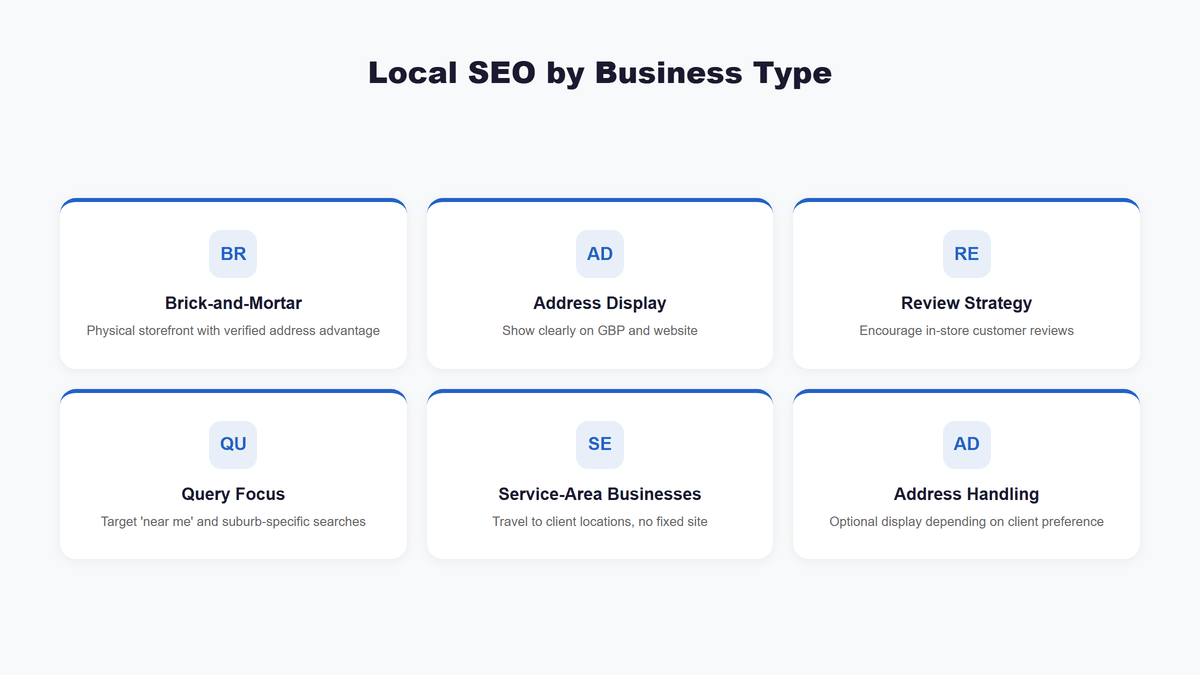
Physical storefronts with a verified address have an advantage with proximity. Display your address clearly on your GBP and website. Encourage in-store customers to leave reviews. Focus on ranking for “near me” and suburb-specific queries.
Local SEO for Service-Area Businesses (SABs)
SABs do not serve customers at a fixed location. A mobile mechanic or cleaning company, for example, travels to the client. For SABs:
- Do not display a physical address on your GBP if you do not want clients visiting
- Set your service areas in your GBP settings using the suburbs and cities you serve
- Build location-specific landing pages for each area
- Proximity is harder to control, so prominence and relevance become more important
This distinction is important. Many guides treat all local businesses the same way. SABs need a different approach to their GBP setup and location page strategy.
Multi-Location Businesses
Create a separate GBP listing for each physical location. Each listing needs its own unique NAP, photos, and reviews. Build individual location pages on your website, each with unique content. Consistent NAP across all listings is non-negotiable.
How to Get Started: A Step-by-Step Action Plan
Follow this framework to build a local SEO foundation.
- Claim and optimise your Google Business Profile. Verify ownership, complete every field, choose accurate categories, and add photos. This is the highest-leverage single action in local SEO.
- Audit and fix your local citations. Use BrightLocal or Whitespark to find inconsistent NAP data across directories. Fix discrepancies starting with the highest-authority listings.
- Conduct local keyword research. Identify suburb and city-level search terms using Semrush or Google Search Console. Prioritise terms with clear commercial intent.
- Optimise your website for local search. Add location pages for every area you serve. Include NAP in the footer. Add LocalBusiness schema markup. Ensure the site is mobile-friendly given Google’s mobile-first indexing, which means Google predominantly uses the mobile version of your site for ranking and indexing.
- Build a review generation strategy. Ask every satisfied customer for a Google review. Make the process simple with a direct review link. Respond to all reviews within 48 hours.
- Build local backlinks and citations. Submit to key Australian directories, pursue local press mentions, and explore sponsorship opportunities in your community.
How Long Does Local SEO Take to Show Results?
This is the most common question. Be prepared for a realistic timeline.
Realistic Timelines
- GBP optimisation: Visible improvements within 2 to 4 weeks in some cases
- Citation building and fixes: 4 to 8 weeks to see ranking impact
- Keyword ranking improvements: Typically 3 to 6 months for meaningful movement
- Competitive markets: Can take 6 to 12 months for significant gains
New businesses with no existing online presence will take longer than established businesses with existing domain authority and review history.
Factors That Affect Speed
- Competition level in your market and location
- Existing domain authority and backlink profile
- Citation health across directories
- Review volume and recency
- Content quality on your website and GBP
Consistent effort compounds. Results build on each other over time.
How to Track and Measure Local SEO Performance
Do not track vanity metrics. Track what connects to your bottom line.
Key Local SEO Metrics to Monitor
- GBP insights: Calls, direction requests, website clicks, photo views
- Local keyword rankings: Position tracking for suburb and city-level terms
- Organic traffic from local queries: Segment in Google Analytics by location
- Review count and average rating: Both are ranking signals and conversion factors
- Conversions from local pages: Form submissions, calls tracked via call tracking
Tools for Tracking Local SEO Results
| Tool | Best For | Cost |
|---|---|---|
| Google Search Console | Organic keyword performance | Free |
| Google Analytics | Website traffic and conversions | Free |
| BrightLocal | Local rank tracking, citation audits, review monitoring | Paid |
| Semrush | Keyword research, rank tracking, competitor analysis | Paid |
| Whitespark | Local citation building and auditing | Paid |
| Moz Local | Citation management and local listing health | Paid |
Set up rank tracking for every local keyword variation you are targeting, including suburb, city, and “near me” combinations.
Is Local SEO Worth It for Your Business?
The data answers this clearly. According to HubSpot, nearly half of all Google searches carry local intent. According to BrightLocal, 88% of local mobile searchers take action within a day. And real-world results confirm it: targeted local SEO campaigns consistently deliver measurable improvements in calls, leads, and revenue for businesses that commit to the process.
Local SEO is not a cost. It is an investment in organic growth that compounds over time, reduces your cost per lead, and puts your business in front of buyers who are already looking for exactly what you offer.
Unlike paid advertising, local SEO builds an asset. Rankings, reviews, and citations accrue value over time. You are not renting visibility. You are earning it.
The question is not whether local SEO is worth it. The question is how long you can afford to wait before starting.
Ready to Improve Your Local Search Visibility?
At Cascade Digital, we take an evidence-driven approach to SEO consulting that starts with the data, not guesswork. Whether you need a full local SEO strategy or a free audit to understand where you stand, our team can map a clear path from your current position to measurable organic growth.
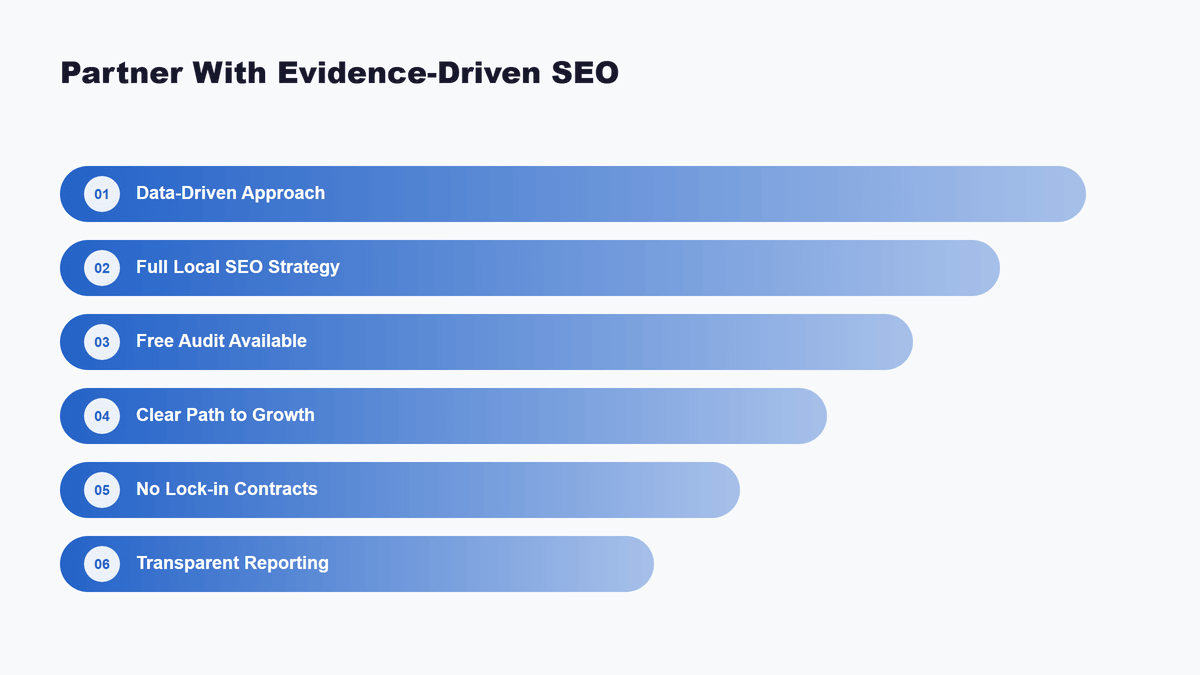
No lock-in contracts. Transparent reporting. Real results.
Book your free strategy session today and find out exactly what it would take to get your business ranking where your best customers are already looking.